In short: There is no single sticker price for a Land Capability Assessment because the fee follows the work your site needs — lot size, the number of soil test locations, complexity, council requirements and travel. For a standard single-dwelling block it is a modest professional fee relative to the overall build. The reliable way to know your number is a fixed-fee quote.
What determines the cost of an LCA
Ask three consultants what a Land Capability Assessment costs and you will get three ranges, because the price is not plucked from the air — it reflects the field and reporting work a particular site demands. Understanding the levers helps you read a quote sensibly and gives you a way to compare quotes on a like-for-like basis rather than on headline price alone.
The main factors that move the fee up or down are consistent across the region, whether your block is in Thurgoona, Wangaratta or out past Holbrook: lot size and the resulting number of soil test locations; the complexity and constraints of the site; the council and reporting requirements that apply; and the travel and access involved in getting our equipment onto the site. We will take each in turn. What you will not find below is a dollar figure — because a number quoted without seeing your site is, at best, a guess, and a fixed-fee quote is a far more useful thing to have.
Lot size and number of soil test locations
The single biggest driver of field cost is how much investigation the land requires. A Land Capability Assessment is only as credible as the soil data behind it, and larger or more variable blocks need more test locations to characterise the land application area properly. On a compact single-dwelling lot with uniform soil, a modest number of test pits or boreholes may be sufficient. A large rural holding, or a block where the soil clearly changes across the site, needs more.
Subdivisions scale the work up further: where each proposed lot will rely on its own on-site wastewater system, the assessment effectively has to prove capability for every lot, which multiplies the soil test locations and the modelling. Where soil samples are sent to a NATA-accredited laboratory for testing, that adds a per-sample cost as well. More locations mean more time in the field, more logging and more analysis — so lot size and test density are usually the first things we discuss when scoping a quote.
Site complexity and constraints
Two blocks of the same size can cost very differently to assess, because complexity drives the depth of investigation and modelling. A flat, well-drained block with deep, uniform, freely draining soil is straightforward. Complexity — and cost — rises when the site brings in constraints such as:
- Steep or variable slope, which limits disposal options and demands closer analysis of runoff and surfacing risk;
- Shallow or seasonally high groundwater, common on low-lying blocks near the Murray, Ovens or Goulburn systems, which governs both the system and the land application area;
- Difficult soils — heavy or dispersive clays, shallow rock or uncontrolled fill — that need more careful characterisation;
- Flooding, drainage lines or tight buffer distances to boundaries, dams, bores and watercourses that squeeze the available area;
- Sensitive receiving environments such as declared water supply catchments, which raise the bar on nutrient and containment analysis.
The more constrained the site, the more work goes into demonstrating that a compliant, sustainable solution exists — and that shows up in the fee. It is also precisely where experienced judgement earns its keep, because a constrained block near Corowa or Mulwala is where a generic report tends to fall over.
Council and reporting requirements
The regulatory framework your site sits under shapes the reporting effort. In New South Wales, an LCA supports a Section 68 approval under the Local Government Act 1993 and Regulation 2021 and is assessed against the NSW Onsite Wastewater Management Guidelines (2025); in Victoria, it supports the council permit required under the Environment Protection Act 2017 and Regulations 2021 and is judged against EPA Victoria's Guideline for onsite wastewater management (2024). Both rely on the design standard AS/NZS 1547:2012.
On top of the state framework, individual councils publish their own on-site wastewater strategies and control plans, some of which require additional analysis — reserve-area assessment, detailed nutrient or phosphorus balances, or specific setbacks — that add to the reporting scope. Because we prepare LCAs on both sides of the border regularly, we know these local expectations and price the report to meet them the first time. For the detail, see our guides to LCA requirements in NSW and LCA requirements in Victoria.
Travel and site access across the region
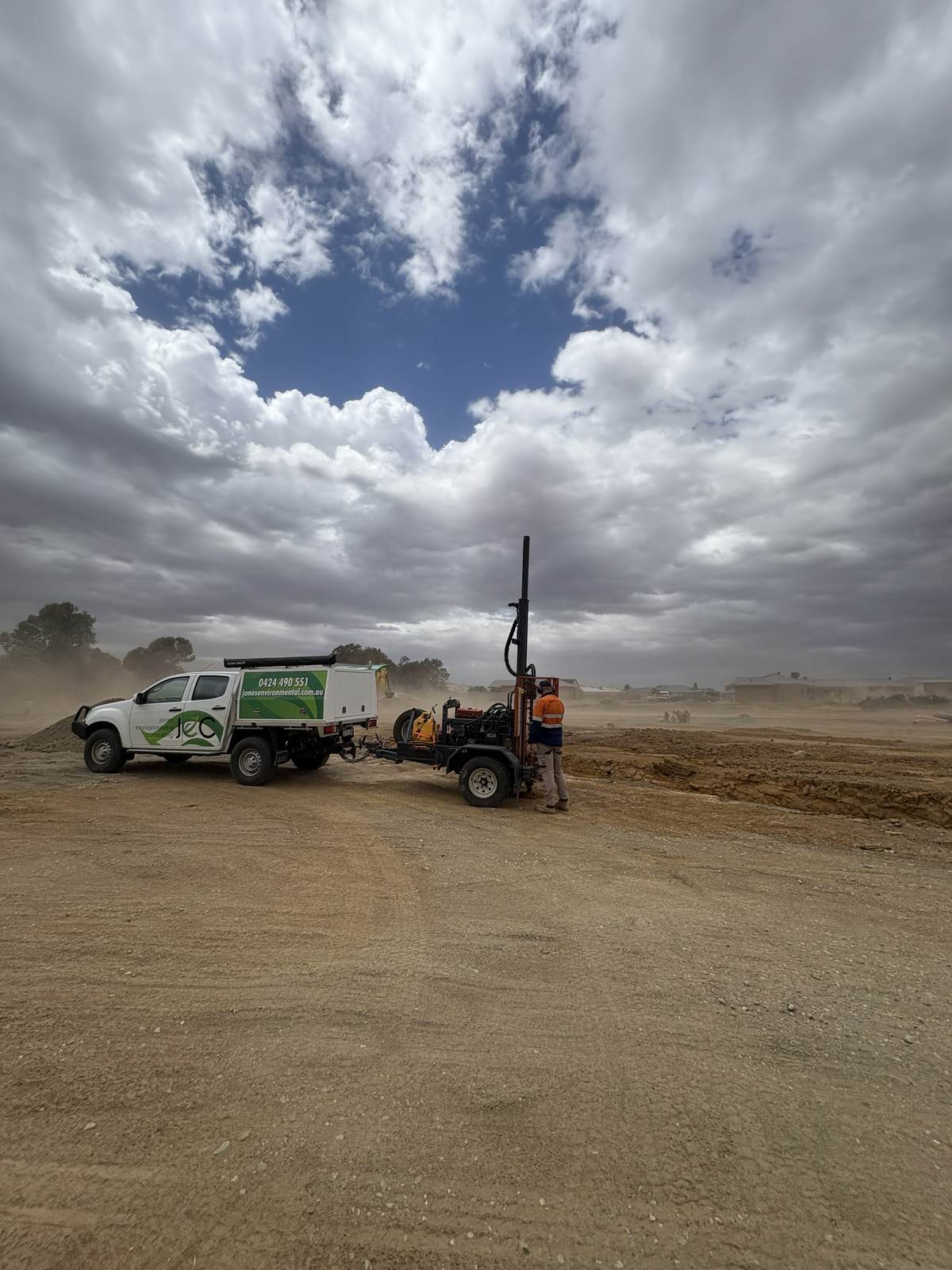
Getting to and onto the site is a real, if unglamorous, cost. A block a short drive from our Albury Wodonga base costs less to mobilise to than one out past Benalla, Yarrawonga, Shepparton or Howlong. Site access matters too: an open, level block our field vehicle and drilling rig can reach directly is quicker to investigate than a landlocked, heavily vegetated or very steep site that needs extra effort to reach the candidate land application area. Because we run in-house field and drilling capability rather than subcontracting it, we can mobilise efficiently and keep this component tight, but honest travel and access allowances are always part of a fair quote.
What you get for the fee
It helps to remember what the fee actually buys. A Jones Environmental LCA is not a form-filling exercise — it is a defensible, council-ready technical report prepared by a qualified environmental scientist. For your fee you receive a desktop review of the lot and its constraints, a site inspection, a soil investigation with the profile logged by horizon, soil classification under AS/NZS 1547, a water and nutrient balance that sizes the land application area, and a clear recommendation of the treatment system, dispersal method and management conditions suited to the site — presented so a council environmental health officer can assess it with confidence. If you are weighing an LCA against a bare septic sizing note, our guide on LCA vs septic assessment explains why the two are not interchangeable.
Why the cheapest quote isn't always the best value
A lower quote can be genuinely competitive — or it can signal a narrower scope: fewer soil test locations, thinner analysis, or a junior preparing a report a senior never reviews. The problem only surfaces later, when a council's environmental health officer requests more information, rejects the report, or the approval stalls while the assessment is redone. At that point the "cheap" LCA has cost you the original fee, a second fee, and weeks of lost time on your build or subdivision.
Because an LCA sits on the critical path and can influence house siting and lot boundaries, a report that is right the first time is almost always the better value, even at a higher headline price. When comparing quotes, look past the number to the scope: how many soil test locations, who prepares and reviews the report, and whether it is written to your specific council's requirements.
How to get an accurate quote
The fastest route to a real figure — not a range — is a fixed-fee quote. To price your LCA accurately we need only a few things: the site address, the proposed development (a new dwelling, a subdivision and how many lots, or a system upgrade), your council, and anything you already know about access or site conditions. With that, we can scope the field work and reporting and give you a fixed fee up front, so there are no surprises.
Every assessment is carried out by a qualified environmental scientist. Patricia Jones, Principal Environmental Scientist and Director, brings around two decades of environmental consulting experience across the region, and Russell Jones, Senior Environmental Scientist and Field Operations Manager, brings around fifteen years of field experience and runs our in-house soil investigation capability across southern NSW and north east Victoria. If you are still working out whether your project needs an assessment at all, start with do I need an LCA? — otherwise, send us the details above and we will turn a "how much?" into a firm number.