In short: A Land Capability Assessment determines whether a block of land can safely and sustainably treat and disperse household wastewater on site. It is the technical report your council relies on to approve a septic or on-site wastewater system for a new home or subdivision that is not connected to sewer.
What is a Land Capability Assessment?
A Land Capability Assessment — usually shortened to LCA — is a site-specific technical report that evaluates whether a parcel of land is capable of treating and dispersing on-site wastewater (sewage effluent) without causing harm to public health, surface water, groundwater or neighbouring land. It is the cornerstone document councils use to decide whether an on-site wastewater management system can be approved on land that is not connected to a reticulated sewer network.
An LCA is far more than a form. It draws together soil science, hydrology, site survey and regulatory knowledge to answer a deceptively simple question: can this land absorb and renovate the volume of effluent a household will generate, every day, for decades, in all seasons? To answer it, an environmental scientist assesses the soil profile, the slope and shape of the land, the depth to groundwater, proximity to waterways and bores, climate and rainfall, and the area physically available to receive treated effluent. Those findings are combined in a water balance and nutrient balance model that sizes the land application area and confirms whether the site can cope.
The assessment is prepared in accordance with the Australian and New Zealand Standard AS/NZS 1547:2012 On-site domestic wastewater management, together with the relevant state guidance — the NSW Onsite Wastewater Management Guidelines (2025) or EPA Victoria's Guideline for onsite wastewater management (2024). The result is a clear recommendation: the type of wastewater treatment system suited to the site, the size and location of the land application area, and any management conditions the landholder must observe.
When is an LCA required?
You will generally need a Land Capability Assessment whenever wastewater must be managed on site rather than piped to sewer. In practice, that means an LCA is required when you are:
- Building a new dwelling on an unsewered rural or rural-residential block;
- Subdividing land where each proposed lot will rely on its own on-site wastewater system (an LCA is often required per lot, or as a combined assessment across the subdivision);
- Installing, replacing or upgrading a septic system or aerated wastewater treatment system (AWTS);
- Increasing the load on an existing system — for example, adding bedrooms, a granny flat or a secondary dwelling;
- Changing land use to something that generates wastewater, such as a farm-stay, cellar door, function venue or expanded agricultural operation.
Councils across the region — from Albury City and Greater Hume in southern NSW to Wodonga, Wangaratta, Benalla and Moira on the Victorian side — routinely request an LCA as a supporting document with a Development Application (DA), a subdivision application, or an application to install an on-site wastewater system. If your planning consultant, surveyor or building designer has told you that your block is "unsewered", an LCA is almost certainly on your critical path. Our guide on whether you need an LCA walks through the common triggers in more detail.
Commission your LCA early. The land application area it identifies can influence the position of the house, the driveway and the lot boundaries in a subdivision. Designing around the assessment is far cheaper than redesigning after it.
NSW requirements
In New South Wales, on-site wastewater management is regulated primarily under the Local Government Act 1993 and the Local Government (General) Regulation 2021. Installing or operating an on-site sewage management system requires council approval — commonly referred to as a Section 68 approval — to "install, construct or alter" and to "operate" a sewage management facility.
The technical benchmark for assessment and design remains AS/NZS 1547:2012, supported by the current NSW guidance — the Onsite Wastewater Management Guidelines (2025), published by the NSW Office of Local Government, which update the earlier On-site Sewage Management guidance. Many NSW councils also publish their own on-site sewage management strategies and development control plans that set local buffer distances, minimum land application areas and reserve-area requirements. An LCA prepared for a NSW site must:
- classify the soil in accordance with the soil categories in AS/NZS 1547;
- apply a water balance (and, where relevant, a nutrient and phosphorus balance) to size the land application area;
- demonstrate that adequate buffer distances can be maintained to boundaries, dwellings, bores, dams and watercourses;
- identify a viable primary land application area and, typically, a reserve area for future use;
- recommend a treatment system and effluent management method appropriate to the soil category and site constraints.
We routinely prepare LCAs for NSW blocks around Albury, Thurgoona, Lavington, Howlong, Holbrook, Corowa, Mulwala and the broader Greater Hume, Federation and Snowy Valleys areas, tailoring each report to the requirements of the relevant council.
Victorian requirements
In Victoria, on-site wastewater management is governed by the Environment Protection Act 2017 and the Environment Protection Regulations 2021, which commenced on 1 July 2021, together with EPA Victoria's Guideline for onsite wastewater management (2024), which replaced the former Code of Practice — Onsite Wastewater Management (Publication 891.4). Systems that treat and retain all wastewater on site and discharge no more than 5,000 litres per day require a permit to install, alter or use an on-site wastewater management system, issued by the local council.
As in NSW, assessment and design follow AS/NZS 1547:2012, and the LCA must demonstrate that all wastewater can be contained and managed within the property boundary with no off-site discharge. Victorian councils in our service area — including Wodonga, Wangaratta, Benalla, Moira (Yarrawonga, Cobram) and Greater Shepparton — assess LCAs against the EPA Code and their own domestic wastewater management plans. A Victorian LCA places particular emphasis on:
- containment of all effluent on site (no discharge to waterways or off the lot);
- land application area sizing supported by soil permeability (design loading rate) and a seasonal water balance;
- protection of declared water supply catchments and sensitive receiving environments;
- appropriate setbacks and buffers consistent with the EPA Code and council policy.
Being based on the border, we prepare LCAs for Victorian sites throughout north east Victoria and the Goulburn–Murray region, and we are equally comfortable with the requirements on either side of the river. If your project straddles the two states, you deal with one team that knows both frameworks.
| Aspect | New South Wales | Victoria |
|---|---|---|
| Primary legislation | Local Government Act 1993; Local Government (General) Regulation 2021 | Environment Protection Act 2017; Environment Protection Regulations 2021 |
| Approval | Section 68 approval (install & operate) | Permit to install, alter or use (systems ≤5,000 L/day) |
| Key guidance | NSW Onsite Wastewater Management Guidelines (2025); council strategies | EPA Victoria Guideline for onsite wastewater management (2024) |
| Design standard | AS/NZS 1547:2012 — On-site domestic wastewater management | |
| Effluent disposal | Contained on site; buffers to sensitive features | All wastewater retained on site; no off-site discharge |
For a deeper treatment of each jurisdiction, see our dedicated guides to LCA requirements in NSW and LCA requirements in Victoria.
Council approval process
The LCA sits within a wider approval pathway. While the exact sequence varies by council and project, a typical process looks like this:
- Pre-lodgement. Your designer, surveyor or planner confirms the block is unsewered and that an LCA is required. This is the ideal point to engage us.
- Land Capability Assessment. We inspect the site, investigate the soils, and prepare the LCA report with a recommended system and land application area.
- Application lodgement. The LCA is submitted with your Development Application (NSW) or planning/building permit and on-site wastewater application (Victoria).
- Council assessment. The council's environmental health officer reviews the LCA against the relevant standard and local policy, and may request clarification.
- Approval and conditions. Council issues the approval or permit, usually with conditions carried through to system installation and the final inspection.
- Installation and commissioning. A licensed plumber installs the approved system; the land application area is established as specified in the LCA.
Because environmental health officers assess LCAs every week, a clear, standards-compliant report that anticipates their questions is the single biggest factor in a smooth, first-time approval. That is what we set out to deliver.
Soil assessment
Soil is the engine of on-site wastewater treatment, so soil assessment is the heart of every LCA. Effluent is renovated as it moves through the soil profile — pathogens are filtered and die off, nutrients are taken up or bound, and organic matter is broken down. If the soil is too tight, effluent ponds and runs off; if it is too coarse or shallow, effluent passes through too quickly to be treated. The assessment characterises the soil to determine how much treated effluent it can safely accept.
We excavate test pits or advance boreholes at representative locations across the proposed land application area and log the soil profile by horizon. For each site we assess:
- Soil texture and structure — from sands through loams to heavy clays, and whether the soil is massive, blocky or well structured;
- Soil category (1–6) under AS/NZS 1547, which sets the indicative design loading rate for effluent;
- Permeability — how readily water moves through each horizon;
- Dispersion and sodicity — assessed using the Emerson aggregate test, because dispersive and sodic soils behave very differently under wetting;
- pH, and phosphorus sorption where nutrient management is critical;
- Depth to limiting layers — rock, hardpan, mottling or a seasonally high watertable.
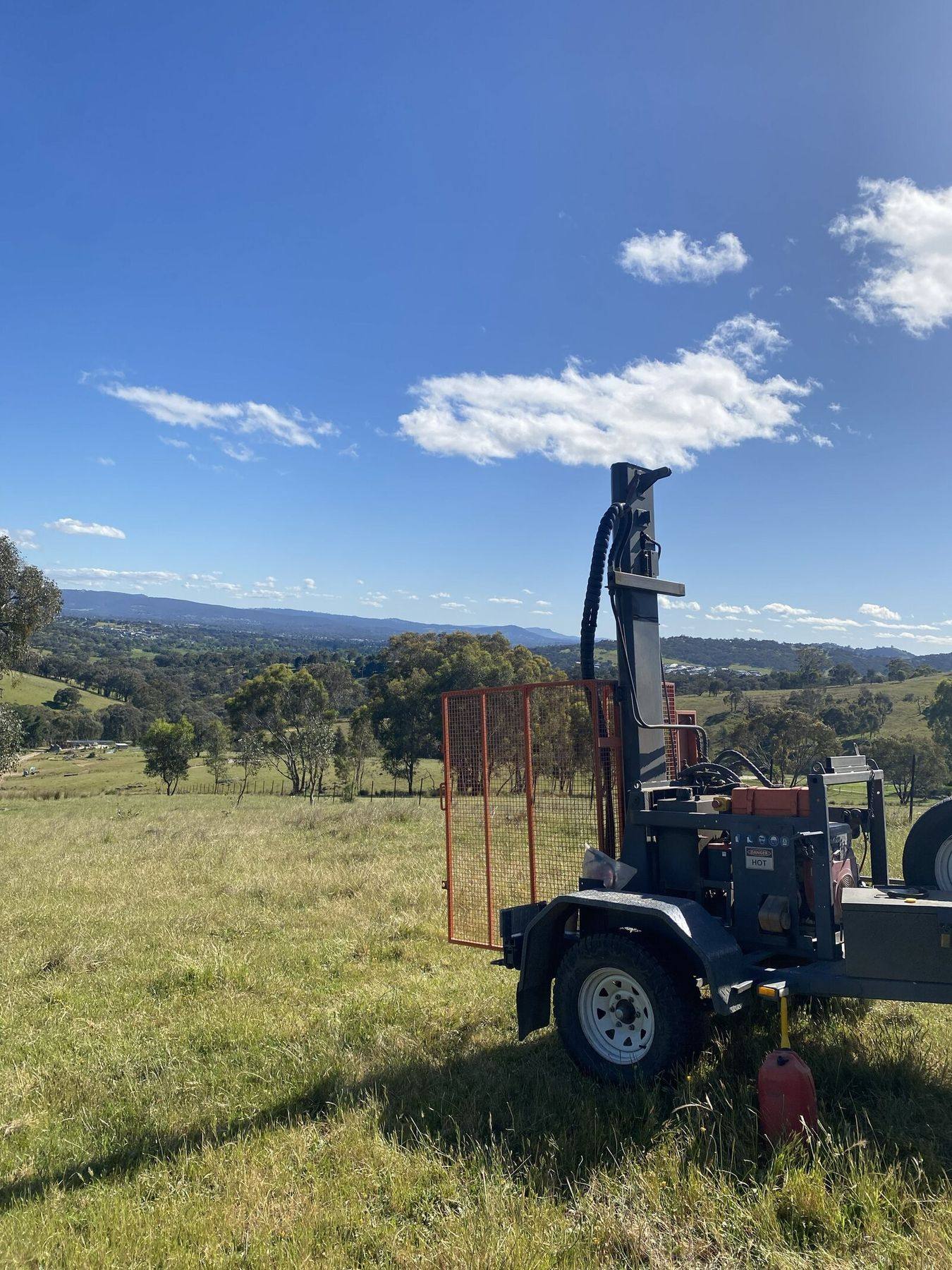
Where required, soil samples are submitted to a NATA-accredited laboratory. The regional soils around Albury, Wodonga and north east Victoria are varied — from the duplex and texture-contrast soils of the granitic and sedimentary country to heavier riverine clays on the floodplains — and a credible LCA reflects what is actually beneath the site, not a generic assumption. Our field and drilling capability lets us investigate soils efficiently, even on tight or difficult access blocks.
Groundwater considerations
Groundwater sets a hard limit on land capability. If the watertable rises close to the surface — even seasonally — there may be insufficient unsaturated soil beneath the land application area to treat effluent before it reaches the water table, creating a risk to groundwater quality and to any bores relying on that resource. During the field investigation we look for direct and indirect evidence of the seasonal high watertable, including standing water in test pits, gley colours and mottling in the soil profile, and any nearby bore or dam records.
The assessment considers the separation distance between the base of the effluent disposal system and the seasonal high watertable, the sensitivity and beneficial uses of the underlying groundwater, and buffer distances to any bores used for drinking water or stock. On low-lying blocks near the Murray, Ovens, Kiewa or Goulburn systems, or on sites with shallow groundwater, this analysis often governs both the type of system recommended and the size and layout of the land application area. Where a project also requires ongoing monitoring, our groundwater monitoring capability can carry the work forward.
Site constraints
Beyond soil and groundwater, an LCA weighs the physical constraints of the site as a whole. Common constraints across regional NSW and Victorian blocks include:
- Slope — steep land increases the risk of effluent surfacing and running off, and limits the disposal methods available;
- Flooding and drainage lines — land subject to inundation or overland flow is generally unsuitable for effluent disposal;
- Available area — there must be enough usable land for the primary land application area plus a reserve, clear of buildings, driveways and easements;
- Buffer distances — to boundaries, dwellings, swimming pools, waterways, dams and bores;
- Rock and fill — shallow rock reduces treatment depth; uncontrolled fill behaves unpredictably;
- Vegetation and existing infrastructure — significant trees, services and setbacks all shape where effluent can go.
Identifying these constraints early lets us position the land application area where the land is genuinely capable, and design a system that works with the site rather than against it.
Septic system and on-site wastewater suitability
Once the land has been characterised, the LCA recommends an on-site wastewater system matched to the site. The main options range from a conventional septic tank with a subsurface disposal field, through to an aerated wastewater treatment system (AWTS) producing higher-quality effluent suitable for subsurface or, in some cases, surface irrigation. Effluent is typically dispersed through subsurface trenches, beds, or pressure-compensating subsurface drip irrigation, with the method chosen to suit the soil category and slope.
Better-treated effluent and pressurised dispersal generally allow effluent to be applied more evenly and over a smaller, more forgiving area, which can be decisive on constrained blocks. The LCA sets out the recommended system, the design loading rate, the size of the land application area, and any conditions — such as reserve area, planting, or diversion of stormwater — needed for the system to perform over its life. The goal is a system that is not only approvable, but genuinely sustainable for the household that will live with it.
Our typical investigation process
Every Jones Environmental LCA follows a structured, defensible methodology:
- Desktop review. We review the lot, proposed development, mapped soils and geology, flood and catchment mapping, rainfall data and the requirements of the relevant council.
- Site inspection. An environmental scientist attends the site to assess landform, slope, drainage, vegetation, existing infrastructure and buffer distances, and to identify the candidate land application area.
- Soil investigation. We excavate test pits or drill boreholes, log the profile by horizon, and collect samples for field and, where required, NATA-accredited laboratory testing.
- Analysis and modelling. Soils are classified under AS/NZS 1547 and a water and nutrient balance is applied to size the land application area for the design wastewater load.
- System recommendation. We recommend a treatment system, dispersal method, land application area and management conditions suited to the site.
- Reporting. You receive a clear, council-ready LCA report with plans, that an environmental health officer can assess with confidence.
Why choose Jones Environmental Consulting
Jones Environmental Consulting is an owner-operated environmental consultancy based in Albury Wodonga, on the NSW–Victoria border. Land Capability Assessments are core business for us, not a sideline — and every assessment is carried out by a qualified environmental scientist, not handed to a junior.
Patricia Jones, our Principal Environmental Scientist and Director, brings two decades of environmental consulting experience across the region, spanning contaminated land, groundwater, waste and land capability work for local government, state agencies, developers and landholders. Russell Jones, Senior Environmental Scientist and Field Operations Manager, has fifteen years of field experience and runs our in-house environmental drilling and soil investigation capability. That combination means the person interpreting your soils has also seen thousands of soil profiles in the ground across southern NSW and north east Victoria.
Clients choose us because we offer:
- Genuine regional expertise — practical knowledge of local soils, geology, groundwater and the specific expectations of councils from Albury and Greater Hume through to Wodonga, Wangaratta, Benalla, Moira and Greater Shepparton;
- Direct senior involvement — you deal with the scientist doing the work, from first call to final report;
- In-house field capability — our own drilling and sampling equipment means faster mobilisation and tighter control of quality and timing;
- Standards-compliant, council-ready reporting — clear reports built around AS/NZS 1547 and the relevant NSW and Victorian frameworks, written to be approved;
- Regulatory fluency on both sides of the border — one team, two states, no gaps.
An LCA is a small part of a project's budget but a critical part of its approval. Getting it right, first time, keeps your build or subdivision moving.